Mythos Slayer uses different growth factors for boss health and gold rewards. Health rises faster, so the same attack setup takes longer to beat later bosses. Purchases, repeat-kill rewards and Rebirth change how quickly you can overcome that gap.
Correction: the previous table rounded some values incorrectly and described Crit Chance as gaining five percentage points per level. It starts at 5% and gains two points per level. This revision also removes development-history claims that cannot be established from the current build.
Version one scaled by digits, and it broke immediately
My first approach was the obvious one. Give each boss an HP value one digit longer than the last. Hundreds, then thousands, then tens of thousands. Clean to implement, easy to reason about.
It fell apart in the early game.
Scaling by digits means every step multiplies by ten. In an idle game your damage does not grow by ten per step. It grows in stages, gated by which units you have summoned and how far you have upgraded them. So the gap between what the boss demanded and what a player could actually produce opened up almost immediately.
The inflation was not gradual. It hit within the first few bosses, which is exactly where you can least afford to lose people.
The problem was that I could no longer feel my own opening
Before I could fix the curve I had to admit something uncomfortable. I was the worst possible person to judge my own early game.
I had played that opening so many times that it had stopped registering. I knew where every upgrade sat. I bought things in the right order without deciding to. A first-time player has none of that, and I had no way to see the game through their hands anymore.
So I stopped playing it myself and started running automated playthroughs instead, with no knowledge of the optimal order baked in. They bought the wrong thing. They sat on gold they should have spent. They stalled in places I had long stopped noticing, because I had been routing around those places on instinct for weeks.
Several separate runs jammed at the same point. That was what I needed. It told me the wall was real and not just me second-guessing my own design.
It did not hand me the answer. It gave me the shape of the problem, which is the part you cannot fix until you can see it.
Using the typing game as a starting point
This is the part I would probably dress up if I were trying to sound clever, so let me just say it plainly.
I did not derive a fresh difficulty curve for Mythos Slayer. I started from the balance work I had already done for Soldier Typing, my typing game, and adapted it for the clicker.
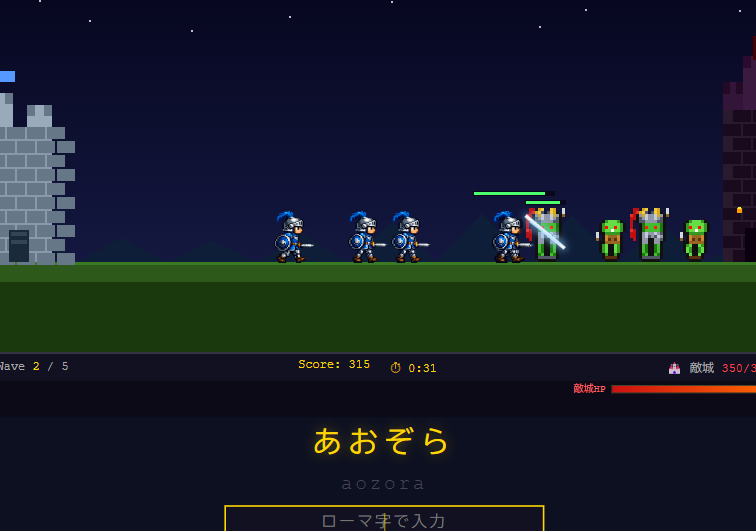
That curve was built by working backwards from average human typing speed. Take how fast a typical person actually inputs, work out roughly how much damage that produces at a given stage of progression, then set boss HP so the fight lands inside the window you want. Not a multiplier picked because it looked right. The target fight length gave me a starting point for tuning.
The translation to a clicker was one substitution. A fast typist becomes a fast tapper. Both provide an input rate to work from, but automatic allies and upgrades still need their own balance pass.
The honest reason I did it this way is that reusing something that already works is easier than building it again. But it turned out to be the better call regardless, because that curve had already survived contact with real players in another game. Starting from something tested beat starting from a blank sheet.
What came out the other side was 2.42.
The development story above describes how I approached tuning. The figures below describe the current build; they are calculations, not measurements of how every player behaves.
The first ten bosses, calculated exactly
In cycle 1, maximum health is floor(300 × 2.42boss number − 1). The floor is applied to the full formula; the next boss is not calculated by multiplying the previous rounded HP value.
| Boss | Cycle-1 HP |
|---|---|
| 1 | 300 |
| 2 | 726 |
| 3 | 1,756 |
| 4 | 4,251 |
| 5 | 10,289 |
| 6 | 24,899 |
| 7 | 60,257 |
| 8 | 145,823 |
| 9 | 352,893 |
| 10 | 854,003 |
Boss 6 therefore has 24,899 HP, which the compact display shows as about 24.9K. Boss 28 has 6,920,478,698,215 HP, or about 6.92T. Compact displays are useful while playing, but should not be read as exact integer values.
Gold grows at a different rate
The base kill reward is floor(80 × 2.05boss number − 1), before cycle and upgrade factors are applied inside the floor. With no bonuses, Boss 1 pays 80 gold and Boss 2 pays 164. Health has multiplied by 2.42, while the reward has multiplied by 2.05.
Every fifth kill of the same boss adds a bonus equal to ten times that kill's normal reward. Including the ordinary payment, that kill pays eleven times the normal amount. A defeated boss respawns after about 1.5 seconds, which matters when comparing rapid farming with a slower, higher-paying target.
Tap gold is derived from the kill-reward calculation. Farmer and Villager income also uses the tap-gold function. As a result, Coin Pouch affects those sources as well as boss kills; describing it as a boss-kill-only upgrade is misleading.
Click damage and critical hits
Base click damage is round(2 × 1.18level × 1.3floor(level / 10)). At levels 0 and 1, that rounds to 2. The current weapon card uses this same function for its preview. Every tenth level adds the 1.3 factor; weapon art stops changing after the tenth weapon, while the formula continues.
Critical chance is min(75%, 5% + 2% × level), reaching its cap after 35 upgrades. Critical damage begins at ×2 and adds 0.3 per level. For average damage, multiply base click damage by 1 + critical chance × (critical multiplier − 1). These are expected values over many attacks, not a promise about the next hit.
Progression continues beyond a full clear
The first defeat of Boss 40 opens the credits. Pressing Next Boss there starts a new cycle with 50 times the health factor and six times the gold factor. Those factors compound on later cycles. Rebirth retains the current cycle, resets purchases and multiplies the existing permanent gold bonus by 1 + 0.4 times the highest boss cleared in that cycle.
There is no calculation awarding income for time spent with the page closed. The attack loop uses animation frames, so a hidden browser tab can also stop or slow progress. Keep the game visible when comparing farming rates.
Use these figures to compare purchases, or play Mythos Slayer. Source: the public game build, functions bossMaxHp, goldReward, hitGold, clickBaseDmg and prestigeFactor.