In my first typing game, keystrokes were attacks. Type fast, deal damage. It works, and it has one problem I could not stop noticing: if you are slow, you lose. Not eventually, not narrowly. You just do not get to finish.
So in this one, keystrokes do not attack. They summon.
Your words put soldiers on the field, and the soldiers do the fighting on their own timer, every 1.2 seconds, whether or not you are still typing. A slow typist builds an army more slowly than a fast one, but the army does not care how it got there. Given enough time, a slow player still wins.
The word length is the whole game
What you type does not just decide how many soldiers appear. It decides which soldiers appear.
| Kana characters | Tier | Who shows up | Damage |
|---|---|---|---|
| 1 to 2 | Apprentice | Villager, Farmer | 6 |
| 3 | Warrior | Swordsman, Dwarf Warrior, Dwarf Soldier | 9 |
| 4 | Elite | Knight, Heavy Infantry, Archer, Elf Archer | 12 to 13 |
| 5 | Hero | Wizard, Warlock, and above | 17–28 |
The tier uses the number of Japanese kana characters, not the number of Latin keys you press. Five or more kana characters select the Hero tier, which includes dark knights, paladins, dragons and angels. The unit is chosen randomly from that tier.
A Hero-tier unit deals 17–28 base damage per attack, compared with 6 for an Apprentice. That is roughly 2.8–4.7 times as much, depending on which unit appears. The attack interval starts from 1.2 seconds with some variation.
Which produces the one piece of advice that actually matters here: when a long word comes up and you are not sure of it, take the extra half second and get it right. A mistake reduces accuracy and breaks the perfect-word streak, but it does not erase the word. You can correct your input and still summon a unit when you finish.
There are 465 unique words in the pool, which is the largest word list I have written for anything.
Everyone fights the same boss on the same day
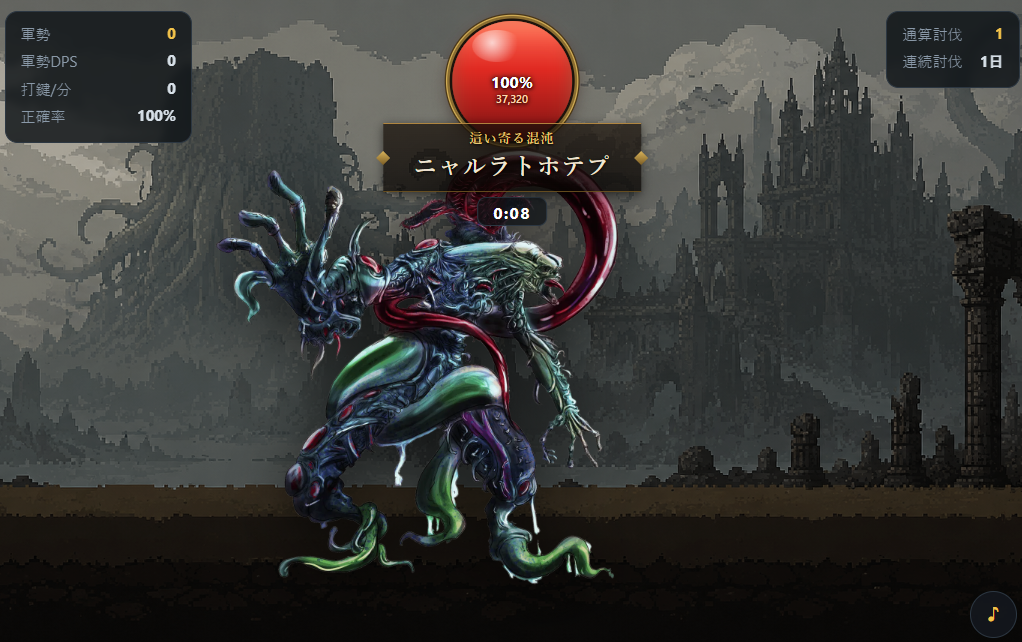
There are 43 bosses. You do not choose between them and you cannot grind them. The game picks one:
todaysBoss = ROSTER[dayIndexInJST % 43]
The date is calculated in Japan time, so the boss rolls over at midnight JST regardless of where you are. Everyone playing on a given day is fighting the same thing, which is the entire reason the leaderboard is interesting rather than just a list of who has played most.
One successful clear per day on a saved profile. An unfinished run can be restarted; after a clear, the normal Start button locks until the next day. Reload after midnight JST to load the new date.
Boss HP, and the fairness problem it created
Boss HP is linear, not exponential:
hp = 16,000 + index × 520
So the weakest boss in the rotation has 16,000 HP and the strongest has 37,840. That is a spread of more than double.
The current score formula multiplies typing speed, accuracy and the boss’s strength:
score = round(correctKeysPerMinute × accuracy × (bossHP / 24000) × 100)
Accuracy is a fraction from 0 to 1. At 120 correct keys per minute and 95% accuracy, a 16,000 HP boss gives 7,600 points; a 37,840 HP boss gives 17,974 points. The stronger boss receives a larger factor. This does not make equal typing statistics score equally across different days. The daily leaderboard compares players facing the same boss.
How the army grows
The sprite cap in this game is 2,000, which the source comment describes as effectively unlimited. I have never come close to it.
In Mythos Slayer, you recruit one of each unit type and then upgrade it. Here, completed words keep adding soldiers. That gives sustained typing a different visual rhythm.
Watching that happen is most of why I built it.
What I would tell you if you asked
- Accuracy over speed on long words. A word of five or more kana characters selects the Hero tier. Finish it carefully to protect your accuracy
- Short words are not wasted. A Villager at 6 damage still attacks every 1.2 seconds forever. Volume is real
- Do not panic at the strong bosses. The score already accounts for them. Higher-HP bosses have a larger score factor; compare your result with other players on the same day
- Come back tomorrow. That is the whole shape of the game. One boss, one successful clear per saved profile per day
Nobody has ever asked me any of this, in fairness. There are no comments on this game and no messages about it. I wrote it down because I opened the source to check something else and wanted to make the scoring and daily limit easier for players to understand.
Cthulhu Typing is free in the browser. It is Japanese typing practice, typed in romaji.